
Migrating to Milvus
Tooling, deployment choices and lessons from real migrations
Sep 2 · 2026

Last time: closing the search gap
Milvus 3.0 brought full-text retrieval, sorting, aggregation and faceting into one engine, and we put it head to head with Elasticsearch on live queries.
lab Run the comparison yourself
Docker Compose, one dataset, side-by-side queries against Elasticsearch and Milvus.
recording Watch the previous webinar
The full walkthrough of what Milvus 3.0 added and how the two engines compared.
TodayFrom comparison to migration: tooling, deployment choices and lessons from real migrations.
What we'll cover today
The migration path
The major stages and decisions in an Elasticsearch / OpenSearch migration to Milvus or Zilliz Cloud
Tooling + real walkthrough
VTS (open source) and Zilliz Migration Service (managed), then a real migration workflow end to end
Licensing & commercial tradeoffs
Licensing models and the commercial considerations behind Elastic Cloud (ESS), OpenSearch and Zilliz Cloud
Deployment choices
Open-source Milvus, Zilliz Cloud and Zilliz BYOC across operating model, control and security
Customer migration stories
Why real teams moved, how they approached it, and what they learned along the way
Live AMA
Around 20 minutes for your migration, architecture and evaluation questions
Why migrate?
Vector search is a plugin
- One HNSW graph per segment: query cost grows with every merge
- Hybrid search is stitched in your code: Rexera gained 40% accuracy in one engine
- Hard ceilings: Orfium maxed out near 500K references, now holds 250M+ vectors
Seen at Orfium, Rexera, OpusSearch
Read & write fight for resource
- Indexing takes nodes down: 123RF's daily ingest dropped OpenSearch nodes
- Latency swings under load: Jobright's P95 was 200 to 500ms, now under 50ms
- Writes wait on graph rebuilds: HelloBike saw ~100x faster writes after migrating
Seen at 123RF, Jobright, HelloBike
Cost scales with data, not value
- RAM-constrained: UNIwise went from hundreds of GB to under 32GB
- Compute and storage grow together: sized for peak, paid for around the clock
- The bill: halving cost post-migration is common
Seen at 123RF, Rexera, UNIwise
None of these are tuning problems. They are architecture problems.
The migration path
Every Elasticsearch / OpenSearch migration passes through the same stages:
- Assess: which indices, which query patterns, what actually needs to move
- Map: mappings to collections, analyzers to Milvus analyzers, scores to scores
- Move: bulk transfer plus change capture, without re-embedding
- Validate: side-by-side results before anything is switched
- Cut over: staged, reversible, boring by design
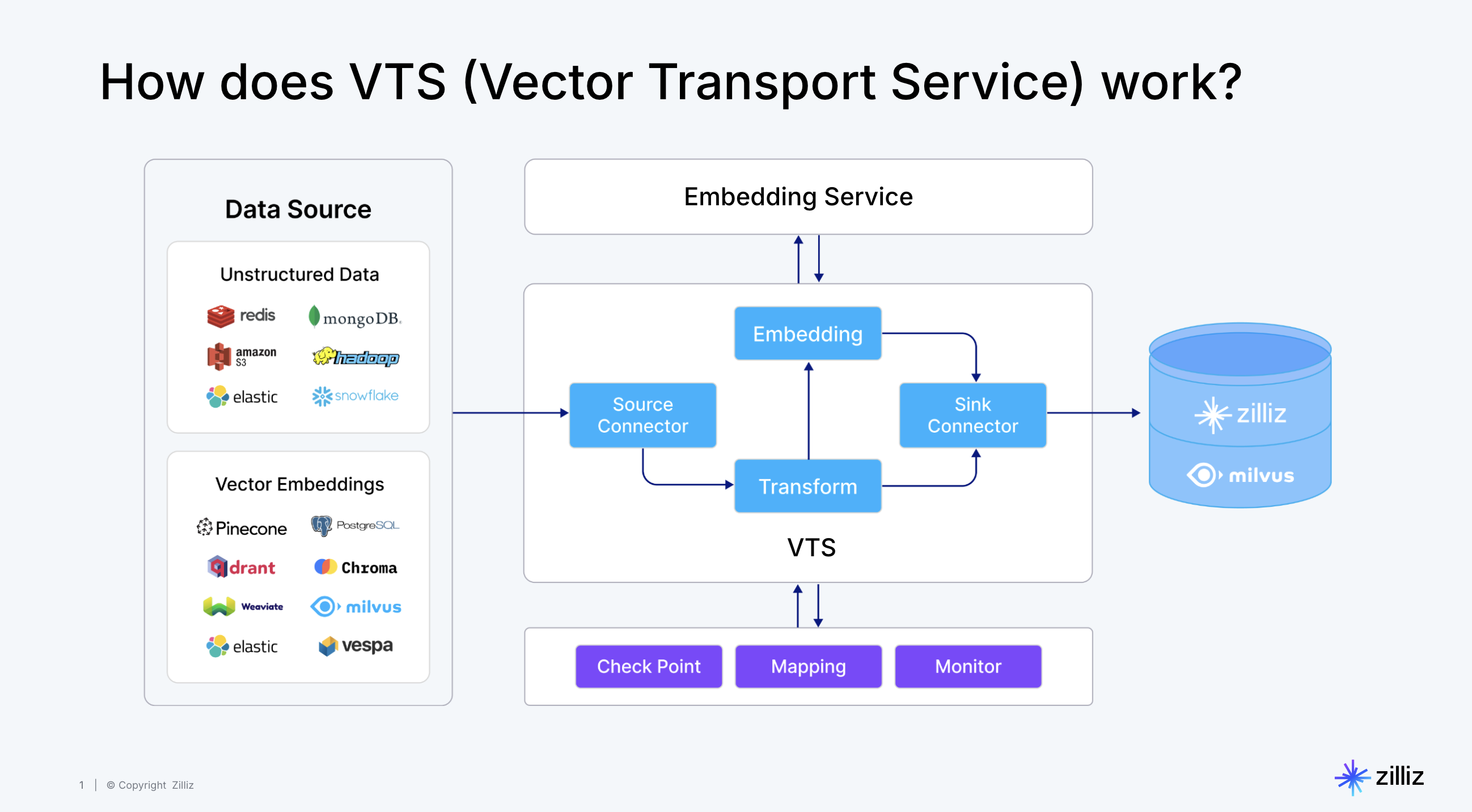
Migration tooling
open source
VTS
Open-source migration tool: streams data from Elasticsearch / OpenSearch into Milvus. Run it yourself, inspect every step
zilliztech/vts
managed
Zilliz Migration Service
Managed service built on VTS: source into Milvus or Zilliz Cloud with the operational heavy lifting handled for you
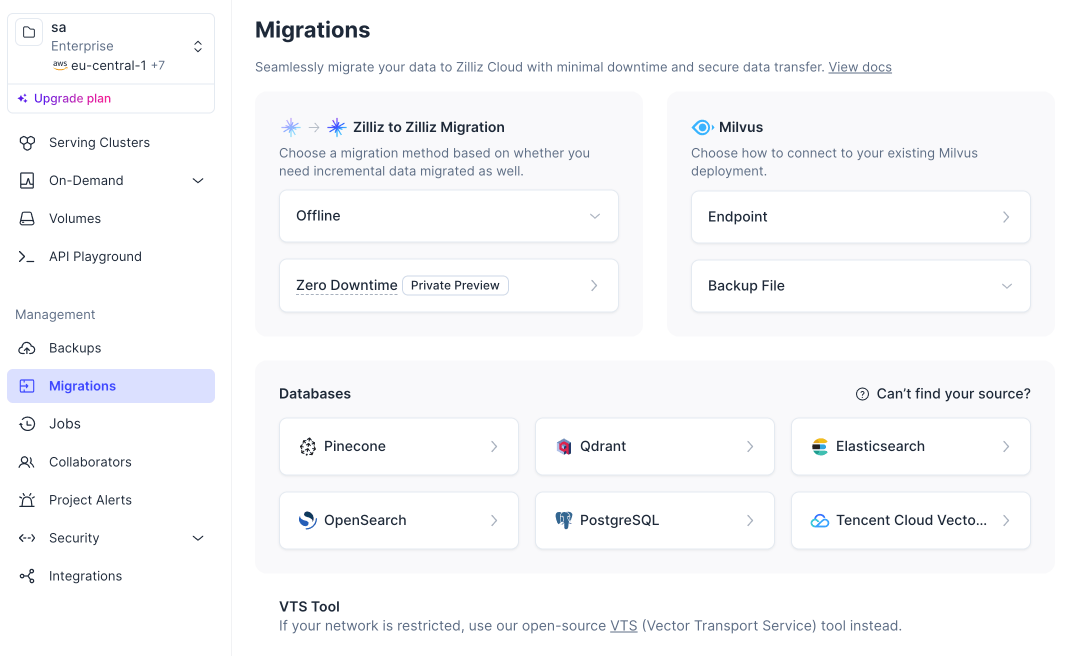 documentation
The lab: three migrations, one dataset
Same ~100k Amazon product documents, loaded from one Parquet: 2×1024-d COSINE FP32 vectors, no re-embedding, same BM25 analyzer chain.
Elasticsearch 9.5.2→Milvus 3.0
VTSlocal
Docker to Docker on the laptop. Open-source VTS, every step inspectable
Elastic Cloud 9.5.2→Zilliz Cloud
VTScloud
Managed to managed, both in AWS eu-west-1. The same VTS job pointed at two cloud endpoints
OpenSearch 3.7.0→Zilliz Cloud
ZMSmanaged
AWS OpenSearch Service into a second Zilliz Cloud cluster via Zilliz Migration Service, from the console
Where everything runs
local · docker
Elasticsearch 9.5.2
Single node, 8 GB / 4 CPU, 4 GB JVM heap. 1 primary / 0 replica
local · docker
Milvus 3.0
Standalone with etcd + MinIO, 8 GB / 4 CPU, 1 replica
aws eu-west-1
Elastic Cloud 9.5.2
2 × c6gd data nodes, 4 GB each. 1 primary / 1 replica
aws eu-west-1
AWS OpenSearch 3.7.0
2 × c8g.large.search data nodes, 4GB each with 120 GB gp3. 5 primary / 1 replica
aws eu-west-1
Zilliz CloudVTS target
1 CU, performance-optimized
aws eu-west-1
Zilliz CloudZMS target
1 CU, performance-optimized. A second, separate cluster
Every cloud service in AWS eu-west-1 to control for network latency. The client for every figure is one laptop: Apple M5, Docker Desktop with all 10 cores, on home fibre internet in London (1 Gbps down / 100 Mbps up).
Cloud lab costs per day
Cloud Standard: $9.93 for two c6gd data nodes, $2.48 Kibana node, $1.24 mandatory master, ~$1 data transfer, $0.09 storage. No auto scale-down, no suspend option.
Source: cloud.elastic.co/pricing$6.82 for two c8g.large.search nodes, $1.06 for 120 GB gp3 each, no dedicated master. No auto scale-down, no suspend option.
Source: calculator.aws
Dedicated Standard: $4.68 compute, $0.01 storage including backups. Auto-scales storage and throughput both ways, can suspend to zero compute when not in use.
Source: zilliz.com/pricing/pricing-guideAll AWS eu-west-1, equivalent hardware specifications, lowest commercial tier. List price per 24h of runtime.
Live walkthrough
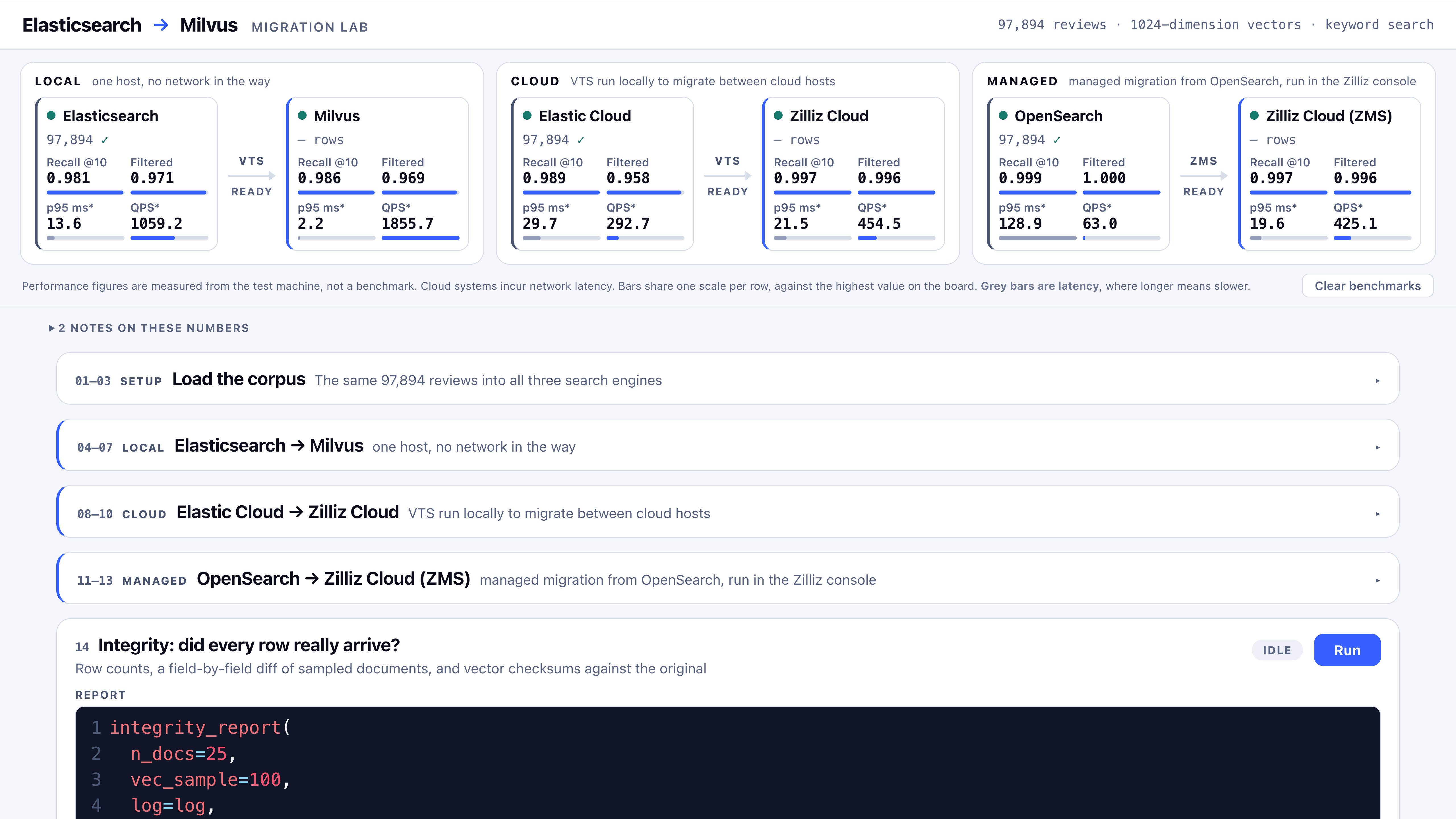
Live walkthrough: three real migrations
Elasticsearch / OpenSearch to Milvus migration workflows, end to end:
- We saw live walkthroughs and benchmarks of:
- Elasticsearch local -> Milvus Local (VTS)
- Elastic Cloud -> Zilliz Cloud (VTS)
- OpenSearch Service -> Zilliz Cloud (ZMS)
How I run the migration
Schema first. The target collection exists before VTS is asked to move a row, so every field and index is explicit up-front.
1 · before the job
Decide the schema
Build the empty collection first: fields, analyzer, BM25 function and indexes, then load it. Indexes are enabled on vector fields and common filter fields.
2 · one JSON document
Submit the job
Source Elasticsearch scrolls the index 500 docs at a time, sink Milvus inserts in batches of 500. Posted to the VTS REST API, polled until SinkWriteCount reaches 97,894, then flush. The cloud leg is the same job with two endpoints swapped
3 · by name, then by target type
How VTS maps fields
Every projected source column needs a Milvus field of the same name; the sink reads the collection schema first and converts each value to the declared type. Two explicit mappings: array_column (ES has no array type) and pk = parent_asin. Computed fields like text_sparse are not sent
ZMS simplifies: the wizard reads the existing index and creates the target collection. Its analyzer step takes our filter chain and the text_sparse name, so BM25 is still declared before rows land. Indexes come afterwards (you can always add indexes to existing fields).
Mapping the schema
Every field type an index needs has a home in Milvus. Most of the mapping is mechanical: the analyzer chain and the vector index are the two decisions that actually matter.
| Need | Elasticsearch / OpenSearch | Milvus | Notes |
|---|---|---|---|
| Primary key | _id, implicit string |
VARCHAR or INT64 with is_primary, auto_id optional |
Keep the source _id: it is the join key for validation |
| Numbers, booleans | long integer double float boolean |
INT64 INT32 INT16 INT8 DOUBLE FLOAT BOOL |
nullable and default_value per field |
| Exact-match strings | keyword |
VARCHAR + INVERTED or BITMAP index |
Filters, sort, group by |
| Full-text, BM25 | text + analyzer |
VARCHAR enable_analyzer → BM25 Function → SPARSE_FLOAT_VECTOR |
Same tokenizer and filter chain, declared per field |
| Term, phrase match | term match_phrase |
enable_match → TEXT_MATCH, PHRASE_MATCH in the filter |
A boolean pre-filter, not a scorer |
| Dense vectors | dense_vector / knn_vector; HNSW with bbq, int8, faiss compression_level |
FLOAT_VECTOR (FLOAT16 BFLOAT16 INT8 BINARY); HNSW IVF_RABITQ DISKANN AUTOINDEX |
Several vector fields per collection, hybrid search across them |
| Learned sparse | sparse_vector / rank_features (ELSER, neural-sparse) |
SPARSE_FLOAT_VECTOR + SPARSE_INVERTED_INDEX, metric IP |
The same field type BM25 writes into |
| Arrays | any field, multi-valued | ARRAY<type> with max_capacity |
array_contains, array_length in filters |
| Objects, nested | object nested flattened |
JSON + JSON path index; dynamic fields for unmapped keys |
Nested docs flatten, or become a second collection |
| Dates | date |
TIMESTAMPTZ, or INT64 epoch |
Range filter and sort either way |
| Geo | geo_point geo_shape |
GEOMETRY, WKT in, ST_* predicates in filters |
Supports distance, bounding polygons etc. |
While that runs: the six-phase strategy
- Steady state: updates flow source → embedding → search; queries embed, then search
- Backfill: stand up the new system, then reindex from the source (clean slate, re-embed) or migrate the index (keeps vectors, no re-embedding)
- Dual ingest: write to both stacks so the new index keeps pace with production
- Dual run: every query hits both engines; serve from the old one, compare results, recall and latency from the new
- Cut over: route live traffic to the new system; the old stack stays warm as rollback
- Decommission: retire the old cluster once confidence and the contract agree
While that runs: how the numbers are made
Ground truth
Exact, not sampled: brute-force top-100 over all 97,894 normalized vectors for 200 fixed queries drawn from the corpus. Text and image spaces scored separately, each against its own truth
Filter specificity
Filtered benches use 20 ≤ price ≤ 60: 27,300 rows, 27.9% of the corpus. Ground truth is recomputed over only those rows, and the bench filter is the same constant by construction
Latency & throughput
One discarded warm-up, then every query timed sequentially: no queueing noise in p50 / p95. QPS is a separate phase with a bounded pool of 8. All client-observed
Recall & BM25 parity
recall@10 is the overlap with the exact top-10. BM25 has no ground truth, so a fixed 20-query set is scored as overlap@10 against the ES-local baseline
Honesty rulesBenches never run concurrently across systems. Latency and QPS are client-observed from my laptop and are illustrative; recall, filtered recall and BM25 overlap are the architectural numbers. For hardware-scale claims, see published VDBBench studies.
Licensing and commercial tradeoffs
open source
OpenSearch
- Apache 2.0: forked from Elasticsearch 7.10.2 in 2021, Linux Foundation since 2024
- Security, alerting, ML and k-NN all ship in the one licence, no paid tier
source available
Elasticsearch
- Left Apache 2.0 in 7.11 for SSPL + Elastic License 2.0; AGPLv3 added in 8.16 as a third option
- Free tier covers vector search, bbq_hnsw and core security; RRF, bbq_disk, semantic_text and inference service require Enterprise license
open source
Milvus
- Apache 2.0 since 2019; LF AI & Data graduated project, vendor-neutral governance
- No paid tier: every feature is in the open build with one codebase for lite, standalone & distributed
aws managed
Amazon OpenSearch Service
- Infrastructure pricing: instance-hour (EC2+66%) plus EBS storage
- No feature tiers: every plugin is included in the instance price
elastic managed
Elastic Cloud (ESS)
- Infrastructure pricing: GB-hour by hardware profile, plus data transfer and snapshot storage
- Subscription tier (Standard, Gold, Platinum, Enterprise) chosen per deployment and gates features and SLA
zilliz managed
Zilliz Cloud
- Infrastructure pricing: CU-hour by performance profile; plus data transfer and storage
- Same Milvus API - open source and cloud stay interchangeable; BYOC and marketplace billing on AWS, GCP and Azure
Deployment choices
Self-managed software
Milvus
The most popular open source vectorDB
- Operations
- You deploy, upgrade, scale and monitor it
- Control
- Total: any infrastructure, any config, source access
- Security
- Your responsibility, end to end
Milvus Lite · Docker · Kubernetes
Fully managed service
Zilliz Cloud
Milvus as a service, tuned and scaled for you
- Operations
- Zilliz runs it: upgrades, scaling, backups, SLA
- Control
- Cluster sizing and config; infrastructure abstracted
- Security
- SOC 2, ISO 27001, HIPAA; RBAC and Private Link
AWS · Google Cloud · Azure
Bring your own cloud
Zilliz Cloud BYOC
Managed control plane, deployed in your VPC
- Operations
- Zilliz operates the data plane inside your account
- Control
- Your account, your network, your keys
- Security
- Data never leaves your cloud boundary
AWS · Google Cloud · Azure

Migrate once: one Milvus API & SDK across all three with seamless migration
You're in good company
123RF: image search at 200M+
OpenSearch→Zilliz Cloudtext-to-image and reverse image searchSource: zilliz.com/customers/123rf
Average, down from ~100ms
vs. unstable OpenSearch environment
Image vectors, growing daily
10M+ per job, no query impact
why they moved
- Latency and throughput unpredictable under real production traffic
- Daily ingest of new assets dropped nodes, so DevOps was firefighting the cluster
what they built
- CLIP embeddings, iterated across two model versions; any model, not a vendor's
- Cluster scaled up and down on expected load; a custom Boost Ranker carries the business ranking rules
what they learned
- Evaluated Pinecone and Weaviate too: some cost more than the problem they were solving
- Image search first, then video and audio follow on the same platform
“Moving to Zilliz Cloud didn't just cut our infrastructure costs dramatically; it gave our engineering team the confidence that search will scale with our business instead of holding it back.” Su-Meng Yong, Engineering Team Lead, 123RF
Plaud: agent memory at 10B+
OpenSearch→Zilliz Cloudagentic RAG and memory for 2M+ devices in 170+ countriesSource: zilliz.com/customers/plaud
Embeddings per region, and growing
Average, <800ms at P99
Billion-scale with no query impact
Incl. new fields & indexes and upgrades
why they moved
- Performance and cost unacceptable at billion-scale semantic and hybrid workloads
- Consumer memory is mostly cold: ignored for months, then needed instantly, so it has to be cheap to keep
what they built
- Hybrid search with decay ranking and document-type weighting; Plaud keeps the fusion and ranking logic
- Multi-region clusters with custom encryption keys, read/write isolation and hot/cold tiering
what they learned
- Migrate once: choose infra for end-state scale
- Benchmark scalar filtering and vector search together; that combination is the real test
“Zilliz Cloud gives us a solid foundation we can trust for agentic memory retrieval at a massive scale, so our team can put its energy into product innovation and user experience, not the plumbing beneath it.” Charles Liu, Co-founder & CTO, Plaud
Live AMA: bring your migration questions.
Thank you!
Questions?
simon @ zilliz.com